
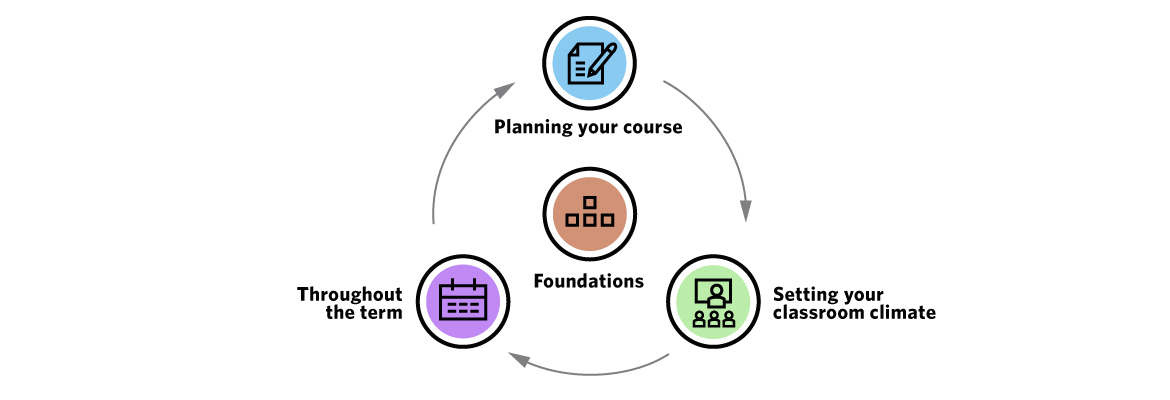
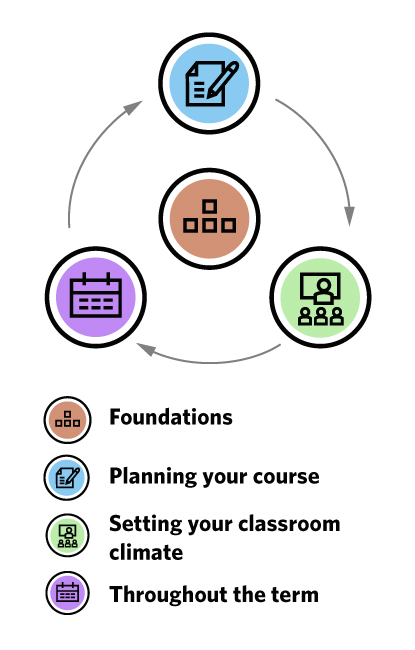
Teaching can present different needs and challenges at different stages of a course. Since teaching is an iterative process, we conceptualize the process in a cycle, as illustrated below. To find resources that can be useful in a particular course stage, use the “Teaching Cycle” filters below. In addition, the “Foundations” category offers resources that are essential for developing knowledge and practices of inclusive teaching. Alternatively, search resources by using the “Topics” filters.
Filter by
Teaching cycle
Topics

This asynchronous course will help you explore the foundational terms, concepts and resources related to Inclusive Teaching at UBC. This course is for anyone who teaches at UBC and who is looking for an introduction to inclusive teaching practices.
The resources explore how knowledge gaps, social location and histories of place affect and inform learning. They were created based on collaborative, ethical, evidence-based, and reciprocal research and educational resource development informed through engagement with local Indigenous communities and scholars across different disciplines.
These five modules are for instructors in all disciplines who are interested in developing their capacity to create more inclusive classrooms and learning environments, but are not sure where to start.
Part of the Inclusive Teaching Modules, this module introduces proactive and situational strategies for navigating challenging conversations in two different contexts: (1) hot button moments, where difficult conversations happen unexpectedly, and (2) supercharged subjects, where difficult conversations can be somewhat anticipated.
Part of the Inclusive Teaching Modules, this 60-80 minute self-paced introductory module walks you through how to make your course design more inclusive with UDL guidelines, in order to increase the quality of student learning.
Part of the Inclusive Teaching Modules, this module is a self-paced introduction to inclusive teaching practices. It is primarily meant for faculty members, instructors, and staff who support teaching in higher education, but anyone is welcome to explore the content.